
New federal data show peak daily use at ages 27 and 28, with nearly one in seven using marijuana almost every day.
Daily marijuana use among American adults has reached an all-time high, and newly released federal data show the trend the industry rarely advertises alongside it: rising addiction and falling abstinence, concentrated among working-age adults and parents.
The figures come from the Monitoring the Future Panel Study, a University of Michigan project funded by the National Institute on Drug Abuse that has tracked the same Americans for decades. Its 2025 survey, released this month, is federal data, not a poll or an advocacy estimate.
Daily use, defined as marijuana on 20 or more of the past 30 days, hit record highs in two age groups at once: 11.8 percent among adults 19 to 30, and 8.5 percent among adults 35 to 50. Peak daily use in the country is now at ages 27 and 28, where 13.9 percent use marijuana nearly every day. At ages 35, 40 and 45, about one in ten Americans now uses daily. Twenty years ago it was one in fifty. These are not experimenting teenagers. They are adults building careers and raising small children.
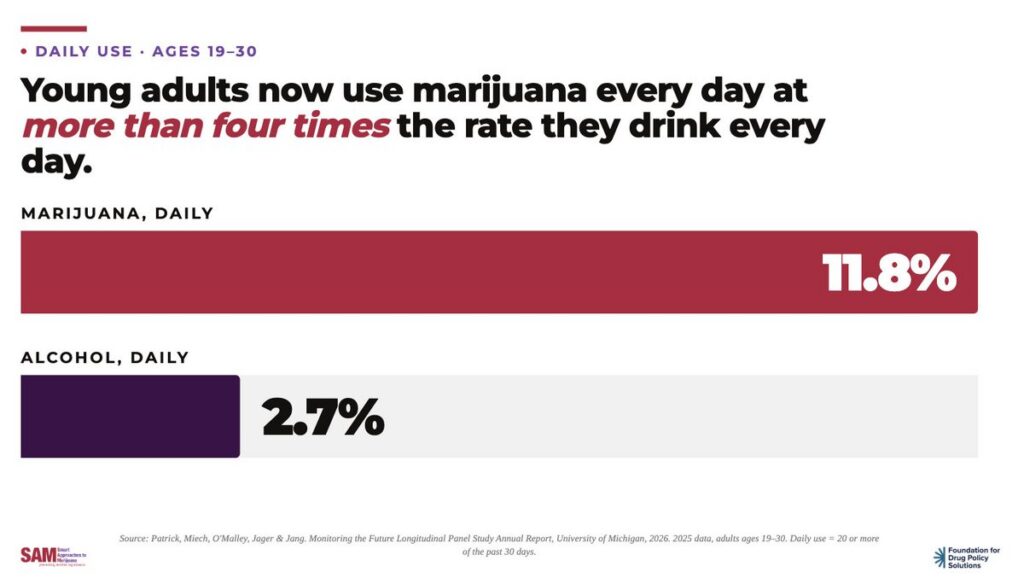
Daily use among adults 19 to 30, 2025. Monitoring the Future Longitudinal Panel Study, University of Michigan. Daily use is defined as use on 20 or more of the past 30 days.
That age profile matters. Federal health agencies note the human brain keeps developing into the mid-twenties, and the CDC warns that regular cannabis use can impair memory, attention, learning and decision-making, with heavier and earlier use linked to a greater risk of cannabis use disorder. The heaviest daily users in this survey fall squarely inside and just past that developmental window.
Many of those daily users are also parents, and the risks extend to the next generation. The American College of Obstetricians and Gynecologists discourages marijuana use during pregnancy and breastfeeding, citing concerns about impaired fetal and infant neurodevelopment, and advises clinicians not to recommend it.
Addiction is climbing with it. Among adults 40 to 50, the share meeting the study’s threshold for disordered marijuana use, based on DSM-5-TR criteria, has nearly doubled since 2017, including a statistically significant jump in the past year. The authors caution the measure is not the same as a clinical diagnosis, but the direction is unmistakable.
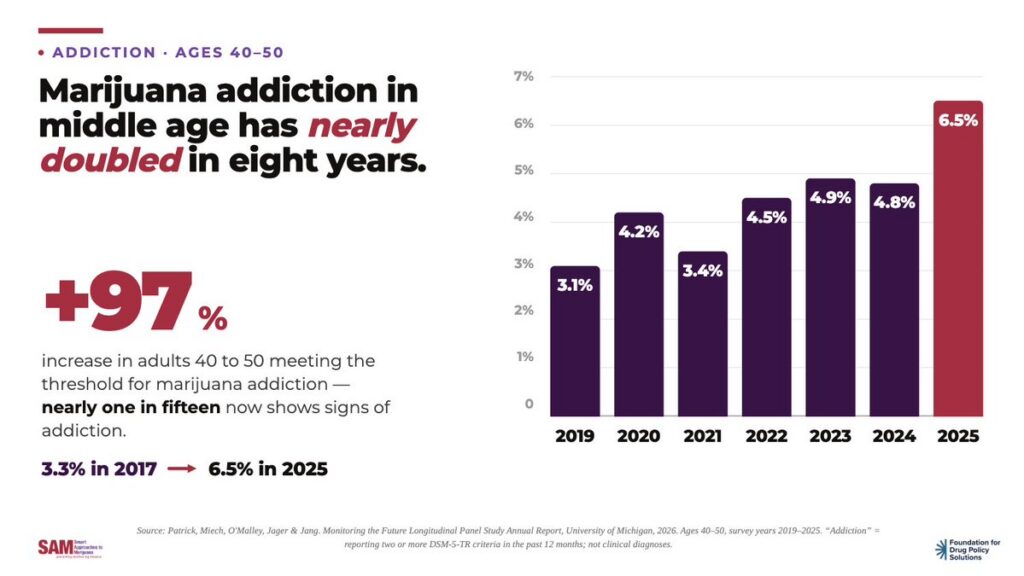
Share of adults 40 to 50 meeting the report’s threshold for disordered marijuana use (two or more DSM-5-TR criteria in the past year; not a clinical diagnosis), survey years 2019 to 2025. Monitoring the Future Longitudinal Panel Study, University of Michigan.
At the same time, abstinence is cratering. The share of adults 40 to 50 who used no marijuana at all fell from 79.2 percent in 2020 to 70.9 percent in 2025. Among adults 55 to 65, it dropped from 81.5 percent to 77.1 percent. Fewer adults are saying no, and more are using every day.
The move toward daily use among older adults carries its own risks. In observational data, the American Heart Association reported that adults who use marijuana daily had 25 percent higher odds of a heart attack and 42 percent higher odds of stroke than nonusers. Older adults tend to carry more cardiovascular risk and more prescription drug interactions to begin with, and they receive the least clinical guidance on marijuana.
The survey also measured intoxicating hemp-derived THC, products like Delta-8, Delta-10, and HHC, for the first time. 11.4 percent of young adults reported using them to get high, with use highest among adults in their early twenties, at ages 21 and 22 (13.6 percent). Those products exist largely because of a federal drafting loophole and are sold largely without restriction.
The overall picture is of a drug being relentlessly marketed into everyday adult life, reaching users at ages when the brain is still maturing, when children are in the home, and when the body is least able to absorb the risk, and pulling a growing share of adults into a habit they find hard to stop.