
Former Arkansas Governor and DEA Administrator Voices Strong Support for Federal Hemp Ban
In the Washington Times, Asa Hutchinson called hemp-derived THC "a child safety problem" and urged Republicans to reject any delay or weakening of the ban.
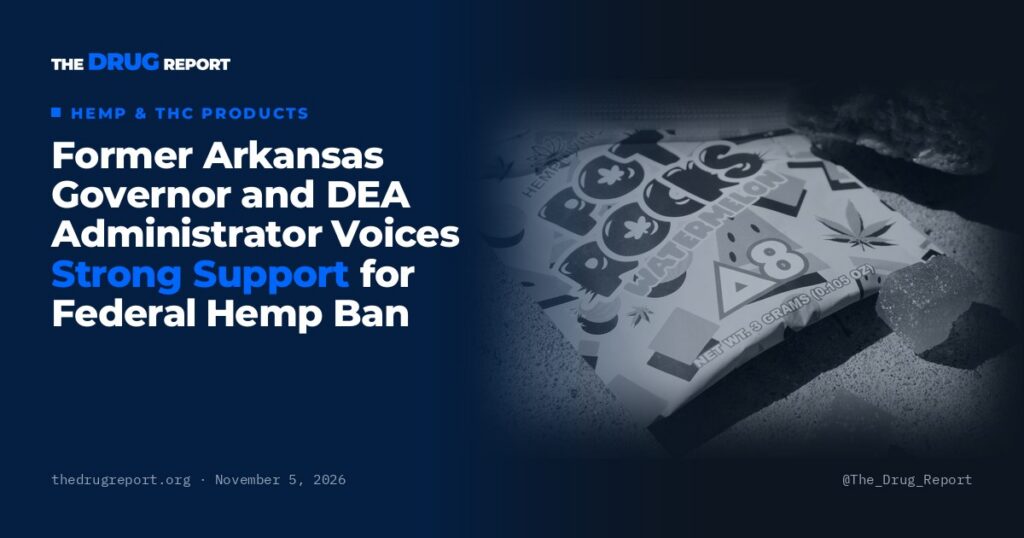
Asa Hutchinson, the former governor of Arkansas and former administrator of the Drug Enforcement Administration (DEA), recently called on Republicans to stand firm on the federal hemp ban and close the loophole that has allowed hemp-derived drugs to be sold nationwide. “This is, above all, a child safety problem,” he wrote in the Washington Times.
Hemp-derived products, which he described as “marijuana in everything but name,” have proliferated throughout the nation because of a loophole in the federal 2018 farm bill. The farm bill permitted manufacturers to chemically convert the cannabinoids in hemp into intoxicating drugs.
In turn, Hutchinson, who served two terms as the governor of Arkansas from 2015 to 2023, explained, “Today, high-potency products such as Delta-8, Delta-10, HHC and THCP are sold at gas stations, smoke shops and online with hardly any oversight.”
Hutchinson, who also served as the administrator of the DEA from 2001 to 2003, noted that “there are often no age checks, no dosing standards and no child-resistant packaging, and the branding frequently borrows cartoon characters and candy styles that appeal to youngsters.” The DEA’s 2025 National Drug Threat Assessment highlighted a Delta-8 product called Trips Ahoy, packaged to copy Chips Ahoy cookies, and one designed to look like Cheetos.
Get stories like this every Friday
The week's drug policy news in one email, every claim sourced. Join tens of thousands of readers.
Hemp THC products are reaching kids
Not surprisingly, these products have found their way into the hands of kids. In 2025, 9.2% of 12th graders used cannabis products made from hemp in the past 12 months, according to the Monitoring the Future survey. The survey’s report noted that these products were made “legal at the federal level with no age restrictions.”
Hutchinson also drew parallels between kratom and hemp, pointing to how both are sold in gas stations and smoke shops with little regulation. “When intoxicating products are allowed onto unregulated shelves next to the candy and energy drinks, young people pay the price,” he said, reminding readers about how the sale of kratom caused the deaths of two students at the University of Mississippi.
Moreover, he argued, “Every hour that police, DEA and ATF spend chasing this unregulated gray market is an hour not spent fighting violent crime and hard narcotics.” Hemp is distracting officials from responding to the larger drug crisis, which resulted in 628,827 overdose deaths between 2018 and 2024.
Addressing concerns about the few farmers who grow hemp as a legitimate non-drug agricultural product, Hutchinson contended, “Congress can protect fiber, grain and seed hemp in full while shutting down the unregulated synthetic-intoxicant industry hiding behind it.”
Hutchinson urges Congress to keep the federal hemp ban
Congress has rightly recognized the problem it inadvertently created in the 2018 farm bill and has moved to close the loophole. Hemp-derived products are scheduled to be banned nationwide on December 11th. Hutchinson said, “That is the right position, and Congress should hold it.”
He concluded with a direct appeal to his colleagues: “To my fellow Republicans: Our party has long stood for protecting families, supporting law enforcement, securing our borders and standing up to China. Closing this loophole advances all four. I urge you to reject any additional delay, any weakening of the law and any effort at repeal.”
Hutchinson has long been a reliable voice for sensible drug policy. In 2022, when Arkansans voted on whether to legalize recreational marijuana, he urged voters to oppose it and said, “they’re selling a harmful drug to the citizens of Arkansas based on promises that look good,” adding that “it’s going to take a lot of education in order to change that climate and to be able to show voters that this would be, in fact, harmful.”
Get The Drug Report every Friday
One free email every Friday: the week's drug policy news, sourced and explained. Read by tens of thousands of people who write, enforce and cover the policy. Unsubscribe anytime.