
Trump Says Blue Cities “Smell of Marijuana.” His Administration Is Rescheduling It.
The president is right about the smell. The product behind it is being normalized by his own Justice Department, the same week it loosened the 7-OH rule.
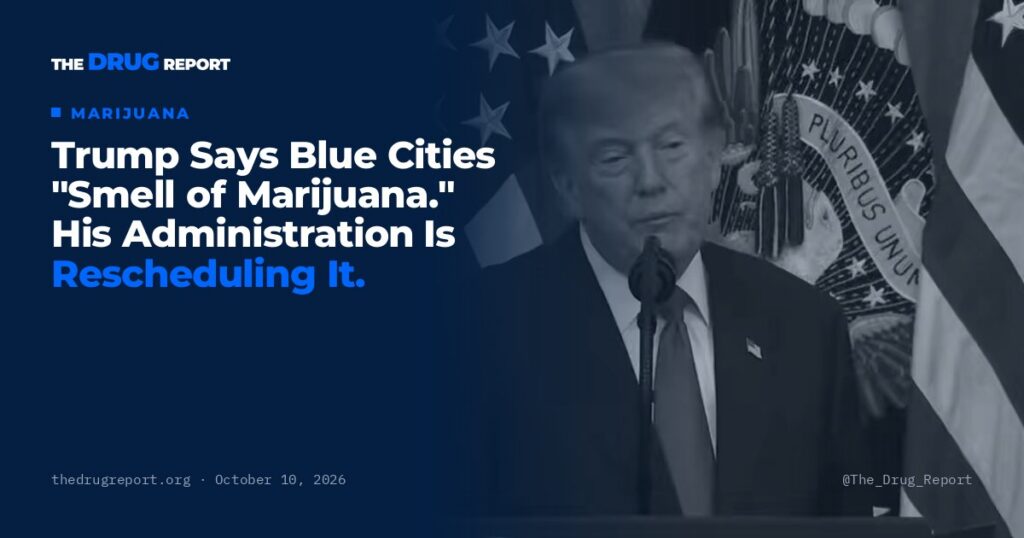
President Trump said Friday that Democrat-run cities smell of marijuana, and that the smell and the crime go together. The complaint lands in the same week his own Justice Department loosened a kratom opioid rule and kept moving marijuana toward Schedule III.
“The sidewalks are disgusting, the streets are disgusting, they’re just in bad shape,” Trump told an East Room audience of Italian-American leaders at a Columbus Day event, according to The Independent. “Everything’s dirty. Smells, smells of marijuana and other things worse than marijuana. They’re all dirty. You know, it’s like the blue, blue-run cities. That’s where the crime is.”
To be fair, Trump is not wrong about the smell. Anyone who has walked through downtown Denver, Manhattan or Washington in the past few years knows it. The question, then, is who put it there.
Get stories like this every Friday
The week's drug policy news in one email, every claim sourced. Join tens of thousands of readers.
What Trump’s marijuana policy has done
First, in December, Trump signed an executive order telling his administration to reclassify marijuana as quickly as possible. Then, in April, Acting Attorney General Todd Blanche moved state-licensed medical marijuana into Schedule III by order, without a hearing, and opened an expedited proceeding to move the rest of the plant with it.
That proceeding is now paused after a federal watchdog found the “two-part test” underpinning it was never the government’s standard. However, the April order still stands, and DEA has already rewritten its drug guide to call state programs “medicine.”
Then came this week. On Friday, hours before Trump’s marijuana remark, DOJ loosened its 7-OH ban, doubling the amount of the kratom opioid that gas stations can sell. In May, Trump himself said his administration was “looking very seriously at natural 7-OH and getting that approved.”
In other words, the “other things worse than marijuana” he smelled on the sidewalk are being sold next to the candy, with his administration’s blessing.
Trump’s marijuana instincts have not changed
Friday was not a one-off. For years, Trump on marijuana has sounded one way while his administration’s paperwork has run the other.
For example, in a 2018 dinner conversation recorded by Lev Parnas and released in 2020, Trump said marijuana “does cause an IQ problem” and that Colorado had “more accidents” after legalizing. Later, at a 2023 NRA forum, he said the FDA should examine whether “genetically engineered cannabis and other narcotics are causing psychotic breaks.”
Likewise, in March 2025, his White House blamed Washington’s “marijuana decriminalization” for opening “the door to disorder.” In August 2025, announcing the federal crime crackdown in Washington, he said he had “heard great things having to do with medical” and “heard bad things having to do with just about everything else.”
Meanwhile, the executive order, the Schedule III order and the 7-OH rollback all came out of the same building. As a result, the president keeps describing a problem his own agencies keep expanding.
The marijuana smell has a supply chain
The smell in Trump’s marijuana complaint is what legalization looks like at street level: public use, storefronts on every block, and a product that today’s industry sells at potencies the 1990s never saw. CDC data show emergency visits for cannabis hyperemesis syndrome climbing nationally, and a DEA pharmacologist testified at the rescheduling hearing that marijuana is not a medicine.
Schedule III would not clean up a single sidewalk. Instead, it would hand the industry a federal tax break and a “medicine” label to print on the packaging.
In short, Trump smelled the problem on Friday. The fix sits in his own Justice Department, and it is running the other way.
Get The Drug Report every Friday
One free email every Friday: the week's drug policy news, sourced and explained. Read by tens of thousands of people who write, enforce and cover the policy. Unsubscribe anytime.