
“The WRONG Move”: DOJ Loosens 7-OH Ban Three Weeks After Ole Miss Deaths
Grassley calls the rollback "the WRONG move"; FDPS says DOJ is bowing to the kratom lobby weeks after two Ole Miss students died.
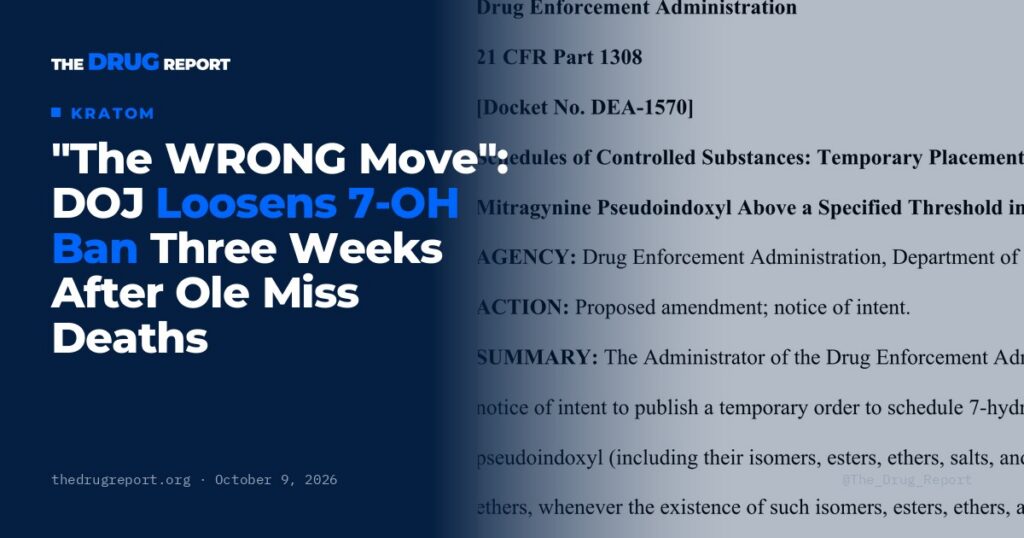
The Justice Department loosened its long-promised 7-OH ban on Friday, doubling the amount of the kratom opioid that gas stations can legally sell. The decision came less than three weeks after two University of Mississippi students died with packaged kratom at the scene.
Senate Judiciary Chairman Chuck Grassley (R-Iowa) wasted no time on the 7-OH rollback. “FDA & DEA’s decision 2weaken their emergency scheduling order is the WRONG move,” he wrote on X Friday. “We need more tools 2 fight these drugs not LESS.”
What changed in the 7-OH ban
DOJ’s press release describes the move as “clearer thresholds targeting dangerous, concentrated products.” However, the fine print tells a different story.
In July, DEA proposed to place 7-OH in Schedule I above 0.05 percent by weight, or 0.5 milligrams per gram. The new notice, based on an Oct. 8 letter from HHS, raises that line to 1 milligram per gram in solids and 1 milligram per milliliter in liquids. In addition, a product stays legal if it carries at least 100 parts mitragynine for every part 7-OH.
Meanwhile, MGPI, a second kratom opioid that DEA says is roughly 100 times as potent as mitragynine, fares even better. DEA put it in Schedule I with no threshold at all on Aug. 26. Under the new plan, it gets the same 1 milligram allowance as 7-OH.
DEA’s own notice concedes the point. The new 7-OH threshold “would permit certain products to remain in the marketplace without being subject to schedule I controls,” it states. In the same breath, it adds that “neither HHS nor DEA has made a finding that these substances are safe to use at below-threshold levels.”
The timeline slips, too. Because DEA is withdrawing the July notice and starting over, the clock resets. The new notice publishes Oct. 14, and no order can issue for at least 30 days after that. The original 7-OH order was supposed to take effect no earlier than Aug. 5. It never did. As a result, more than three months later, 7-OH remains uncontrolled under federal law.
Grassley and FDPS push back
In fact, Grassley has been pressing the other direction for weeks. On Oct. 2 he wrote that “All Kratom is deadly” and told the administration to “put out final 7OH rule NOW.” On Oct. 7 he, Sen. Mike Lee and Sen. Susan Collins asked DEA and FDA to schedule the entire kratom plant.
The Foundation for Drug Policy Solutions (FDPS) condemned the 7-OH rollback within hours. “Two young men are dead, and kratom products were found at both scenes. DOJ’s answer now is to cater to the American Kratom Association and loosen the restrictions on these products,” said Dr. Kevin Sabet, the group’s president.
“This summer the government was ready to ban these drugs. Today it’s bowing to industry lobbyists,” Sabet added. “That’s a gift to the kratom industry, and the families of children killed by kratom will pay for it.”
Meanwhile, FDPS has been running a television ad since Sept. 29 asking President Trump and Congress to go beyond a 7-OH ban and outlaw kratom in every form. Its tagline: “Saturdays should be about football, not funerals.”
The deaths DEA counted before the 7-OH rollback
The notice that loosens the 7-OH rule also catalogs the harm. DEA’s toxicology program has identified 7-OH in 85 overdose cases since 2019, and 55 of them were fatal. It found MGPI in 31 overdose cases in a single year, 25 of them fatal. Poison centers logged 165 exposures to 7-OH in the first seven months of 2025 alone.
Likewise, the broader numbers point the same way. CDC data tie kratom to at least 5,208 overdose deaths from 2020 to 2024. Iowa’s governor has cited 45 kratom-associated deaths in her state since 2024. Massachusetts banned the plant for a year after counting 107.
Then came Oxford, Mississippi. Investigators recovered packaged kratom in both Ole Miss death investigations on Sept. 21. Authorities have not confirmed that kratom contributed to either death, and toxicology results are pending. Even so, the deaths set off a wave of calls for a federal kratom ban that goes beyond 7-OH, from Fox News host Laura Ingraham to a bipartisan bloc of senators.
Instead, the first federal action on 7-OH since those deaths raises the amount of it a gas station can sell.
Get The Drug Report every Friday
The week's drug policy news, sourced and explained. Free. Read by tens of thousands of people who write, enforce and cover the policy.