
Sheehy-Klobuchar Hemp Bill Is “Dead on Arrival”
Sheehy and Klobuchar can't even get their own parties on board.
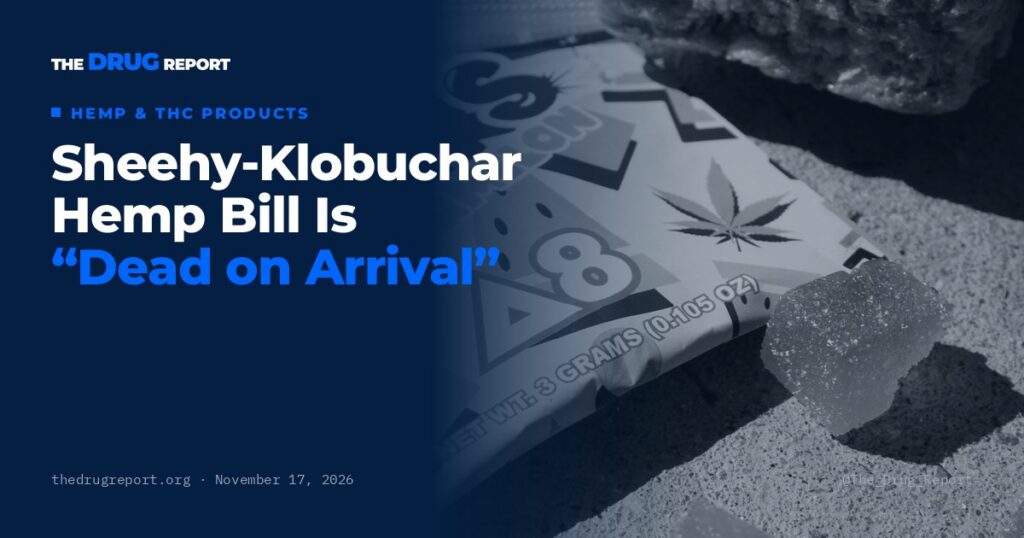
The Sheehy-Klobuchar hemp bill introduced Tuesday is “dead on arrival,” according to Kevin Sabet, president of Smart Approaches to Marijuana. The Hemp Guardrails Act, from Sens. Tim Sheehy (R-Mont.) and Amy Klobuchar (D-Minn.), would replace the federal ban on intoxicating hemp with a new FDA framework.
“Congress already voted to close this loophole,” Sabet said. “This debate is already over. The question is simple: will Congress keep its word to America’s kids and put them first, or will they cow to this addiction industry?”
What the Sheehy-Klobuchar Hemp Bill Would Do
Congress closed the 2018 Farm Bill’s hemp loophole last November. The new law limits hemp products to 0.4 milligrams of THC per container. A stopgap spending bill pushed its effective date from Nov. 12 to Dec. 11.
The Sheehy-Klobuchar bill would set a 1 percent total THC limit on a dry-weight basis and bar sales to anyone under 21. It would also ban smokable hemp flower and direct the FDA to write packaging, labeling and testing rules.
Get stories like this every Friday
The week's drug policy news in one email, every claim sourced. Join tens of thousands of readers.
Sheehy says the bill “will put every bad actor in the hemp space out of business and keep intoxicating products out of the hands of children.” Klobuchar says it “would keep safe hemp products on store shelves.”
Sabet disagrees. “This bill doesn’t add guardrails; it removes them,” he said. He noted that it drops the per-container cap and more than triples the THC a product can hold and still count as hemp. Under the new limit, he said, a single 12-ounce drink could contain roughly 3,500 milligrams of THC, or 700 standard doses.
He added that the bill “asks the FDA to police the whole market without a dollar in new funding.” The sponsors’ announcement does not mention new money for the agency.
Hemp Bill Faces Opposition in Both Parties
“Senators Sheehy and Klobuchar can’t even get their own caucuses on board,” Sabet said.
In August, Sens. Ted Budd (R-N.C.) and Pete Ricketts (R-Neb.) filed an amendment to strip the delay from the stopgap bill. “There is no loophole worth putting a child’s wellbeing at risk,” Budd said on the Senate floor. Sen. Kirsten Gillibrand of New York became the first Democrat to cosponsor it.
The Senate voted 61-32 to keep the one-month delay. But a short delay is not a rewrite of the law. Thirty-five state attorneys general have urged Congress not to weaken the ban, and Ricketts won reelection two weeks ago.
Sheehy has already said hemp THC should be regulated “just like alcohol.” Researchers have also found that as much as 80 percent of hemp THC edibles could not have gotten their THC from hemp at all.
The ban takes full effect Dec. 11. “As it stands,” Sabet said, “this bill is dead on arrival.”
Get The Drug Report every Friday
One free email every Friday: the week's drug policy news, sourced and explained. Read by tens of thousands of people who write, enforce and cover the policy. Unsubscribe anytime.