
This article was originally published in Psychology Today and is republished here with permission.
Why will one person work steadily toward a positive long-term goal, while another spends their entire day doing everything possible to find and use alcohol, cocaine, opioids, nicotine, or other drugs—despite knowing the drug may destroy a relationship, cost a job, or even end their life?
For more than 50 years, I have tried to understand this conundrum. Saying people with addiction value getting high more than anything else is inadequate. The drug may no longer be pleasurable and may be taken mainly to avoid withdrawal or feel normal. Addicted people may hate what substance use has done to their lives and genuinely intend to stop. Yet when craving, stress, withdrawal, or a conditioned cue arrives, the brain yet again mobilizes extraordinary energy to obtain the substance.
New research on orexin neurons may help explain how drug reward becomes an intense and unrelenting wanting, with wakefulness, concerted effort, and persistent pursuit. Orexin may energize the brain’s motivational system, signaling dopamine neurons to mobilize around a goal or reward.
A small population of hypothalamic orexin neurons projects widely through the brain, influencing dopamine, stress, attention, and autonomic systems.
Orexin
Also called hypocretin, orexin was discovered by two research groups in 1998. First associated with appetite, it was subsequently identified as the missing wakefulness signal in narcolepsy type 1.
Reward neuroscience distinguishes “liking” from “wanting.” Liking is pleasure when a reward is consumed; wanting is the sometimes-intense incentive pull making us seek a reward. Orexin appears especially important to wanting and pursuing. It helps determine how much effort is made and how long the person will keep trying.
Orexin organizes the focus and behavioral energy needed to doggedly pursue drugs—a task the user’s brain redefines as very important.
In a recent Proceedings of the National Academy of Sciences study, researchers led by Hiroyuki Mizoguchi at Nagoya University recorded orexin-neuron activity while rats performed touchscreen tasks for food. Their activity rose as the reward became imminent and declined after it was received. But when the expected reward did not arrive, their activity remained elevated, as if they were propelled on by an internal motivator saying: Keep looking. Keep working. Try again. Although this study examined food rather than drugs, the findings can also be a model for understanding the extraordinary persistence seen in addiction.
The signal was also stronger when a greater number of responses were required for the reward and as the cost of successive rewards increased. However, temporarily suppressing orexin neurons during reward anticipation reduced responding and lowered the point at which the animals stopped trying.
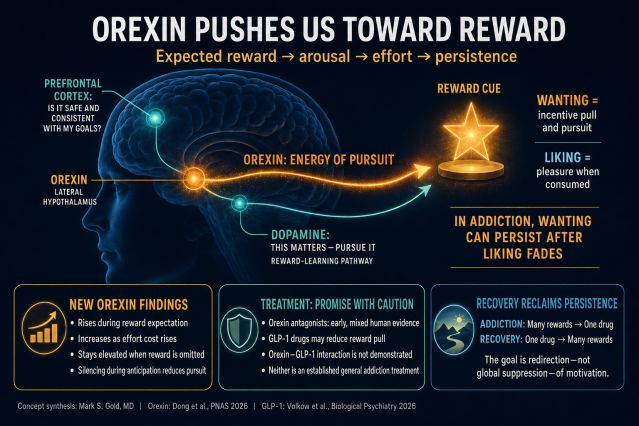
Orexin Pushes Us Toward Reward
Source: Mark Gold, MD with permission
Dopamine teaches the brain, “Drugs matter. Remember and Pursue them.” Orexin may ask, “How much energy should I mobilize? It’s taking everything that I have; should I keep going?” The prefrontal cortex cautions, “Is this really safe and consistent with the life I want?” In addiction, the loss of prefrontal influences can leave the person stuck with narrowed behaviors and interests while drug-seeking becomes disproportionately dominant.
When Wanting Overpowers Reason
Repeated drug use changes everything. It does not erase past learning and experience so much as overlay them with powerful new learning that biases decisions toward drug use. Drug cues become triggers that seem impossible to ignore. They acquire disproportionate importance and progressively narrow priorities until only the drug matters.
This helps explain a clinical contradiction I have witnessed throughout my career. A patient may understand that smoking caused their cancer—and still smoke again. Physicians know the consequences of drug use and addiction better than almost anyone, yet they develop addictions and die from overdoses. In the addicted brain, drugs can become an acquired primary drive, allowing craving to overpower knowledge and govern behavior.
THE BASICS
Two systems are actively competing. The slow planning, weighing the future, health, and happiness is pitted against fast, intense craving that shifts focus to the drug and overrules every other input by defining drug use as an emergency. Craving narrows the mind to one task: get the drug now. After use, deliberate reasoning may bring regret and another sincere desire to quit.
The most severe form is wanting without liking. A person may get little or no euphoria from substance use, yet drug cues still trigger drug anticipation, use planning, risk-taking, and persistence. Orexin may help connect cues, withdrawal, stress, and sleep loss to the energy required to keep searching for the substance reward. It is not the single cause of addiction, but one part of a new, larger motivational pursuit system that addiction captures.
Addiction: Many rewards → One dominant reward
Recovery: One dominant reward → Many healthy rewards
For recovery, relationships, family, work, exercise, sleep, service, spirituality, treatment, and ordinary pleasures must gradually become valuable and motivating again.
More Motivation Isn’t Always Better
A companion study from Mizoguchi and the same Nagoya group offers an intriguing new caution: orexin influences not only persistence but also risky decision-making. Activating orexin neurons shifted rats toward larger but less certain rewards—much as a large gambling win can disproportionately shape later choices. Suvorexant, a dual orexin-receptor antagonist approved for insomnia, reversed this bias.
Too little Orexin signaling impairs wakefulness and sustained effort, but excessive or misdirected activation may promote risky, incessant reward-seeking.
In August 2026, the FDA approved oveporexton (Orzeyful), an orexin-2 receptor agonist, for adults with narcolepsy type 1. It restores deficient wakefulness signaling and differs fundamentally from orexin antagonists. Its implications for people with substance use disorders require careful study.
Theoretically, orexin antagonism is a potential new SUD treatment approach, especially when insomnia, withdrawal, or environmental cues drive more drug-seeking. In a small opioid use disorder study, suvorexant improved sleep and showed preliminary reductions in withdrawal and craving. Early cocaine studies suggested that Orexin antagonism effects may vary by drug, receptor, dose, and timing. Larger randomized controlled trials are needed before determining efficacy or a role in treatment.
Where GLP-1 Treatments May Fit
GLP-1 or GIP/GLP receptor agonist medications (like semaglutide or tirzepatide) interact with these brain reward and arousal pathways, including orexin and dopamine systems, to help quiet the intense, driven pursuit of rewards. Some patients taking GLP-1 receptor agonists such as semaglutide describe less “noise” and preoccupation, and pull toward alcohol, nicotine, or highly-reinforcing food.
Early GLP alcohol trials are encouraging but mixed. Small randomized studies found reductions in some measures of craving, heavy drinking, or consumption per drinking day, but not all primary outcomes. These are possible harm-reduction signals—not proof of abstinence, an established treatment, or a cure.
Orexin and GLP-1 may act at different points in motivated behavior circuits. GLP-1 treatments may reduce the pull of an addictive reward, while orexin regulates the energy and persistence mobilized to pursue it. This is a compelling working model, but not yet a demonstrated therapeutic mechanism.
Recovery Must Reclaim Persistence
Medication may quiet craving and open a window for change. Recovery uses that window to redirect motivation toward family, work, treatment, service, and ordinary, non-drug pleasures.
Addiction is not only about pleasure. Long after the pleasure is gone, conditioned wanting can keep a person searching for the drug.
The brain’s capacity to persist is not the enemy. Instead, addiction hijacks it. Recovery must reclaim it.